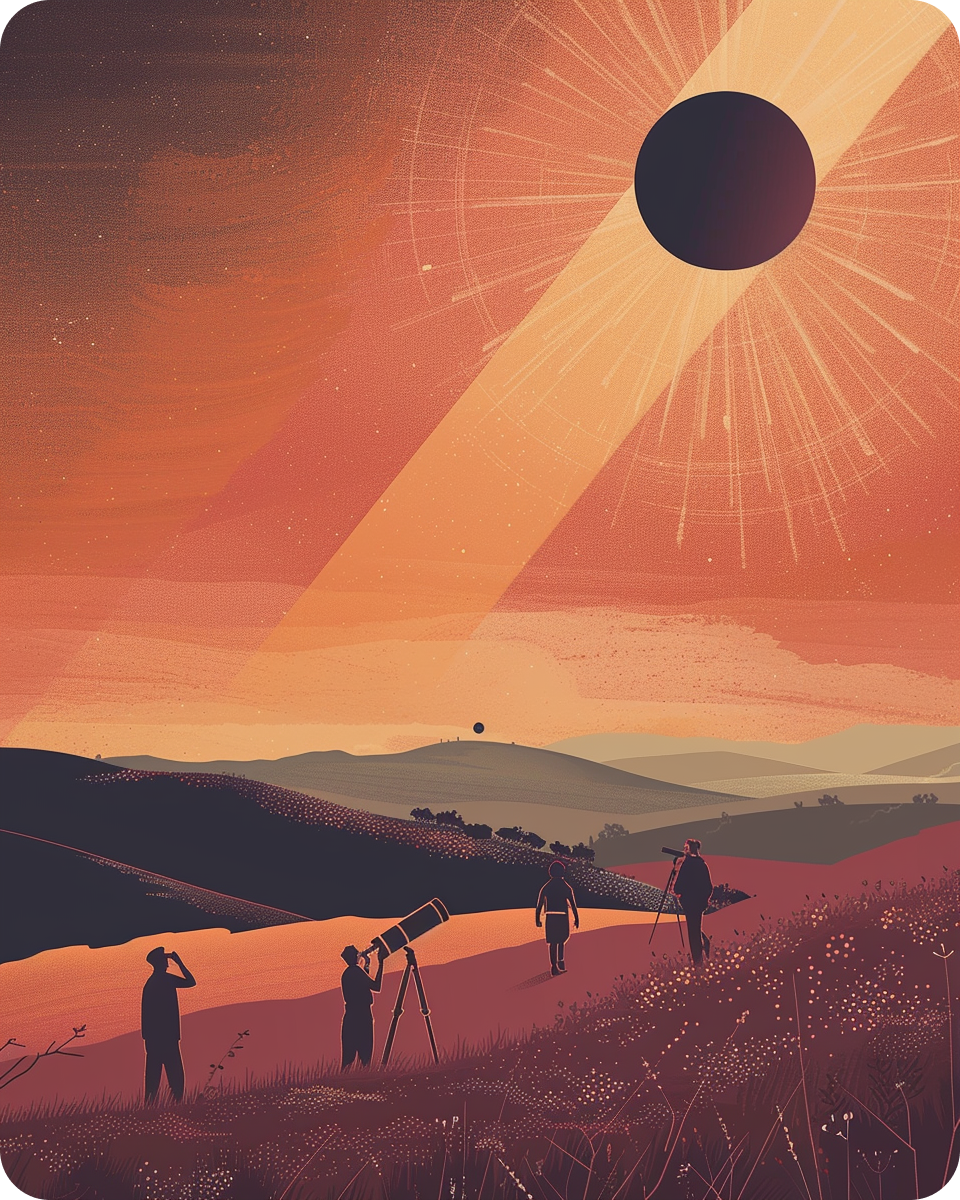
Six minutes and 23 seconds. That is the maximum duration of totality somewhere along the path of the total solar eclipse on 2 August 2027. For those minutes, the Moon will cover the Sun completely, revealing its pale outer atmosphere while daylight gives way to an extraordinary twilight. It will be the longest total solar eclipse for the rest of this extraordinary 21st century. If you’re reading this in 2026 or 2027, that is in the lifetime that’s yours and mine.
There is a catch, of course: those six minutes and 23 seconds are available only near the point of greatest duration, in Egypt. You cannot stand anywhere along the route and expect to get the same show. Around Tarifa, at the southern tip of Spain, totality is expected to last about four minutes and 39 seconds, or 279 seconds. This is still an unusually generous stretch of time to experience the moment when the Sun disappears.
That is part of what makes 2027 so exciting for us at Total Together. This is a rare, long eclipse crossing places people can actually travel to: southern Spain, North Africa and beyond. It offers the chance to build a journey around the eclipse rather than treating it as a frantic dash to a point on a map. For many of us, the opportunity to experience this particular eclipse, in this part of the world, will come only once.
What happens when the Sun disappears?
A partial eclipse is fascinating. You can watch the Moon take an ever larger bite out of the Sun through proper eclipse glasses. The light may seem strangely flat, and little crescents can appear in the shadows beneath trees.
But even a very deep partial eclipse is different from totality.
When the last bright piece of the Sun vanishes, the atmosphere around you changes. The sky darkens. The horizon may glow with the colours of sunset in several directions at once. Bright planets or stars may become visible. The Sun’s corona—its delicate outer atmosphere—appears around the black circle of the Moon. Then, far too soon, sunlight returns.
You can read that description a hundred times and still be surprised by how it feels. People cheer. People fall silent. People who thought they had come to watch an interesting astronomical event find themselves talking about it years later.
There is one essential detail in planning for 2027: you must be inside the path of totality to see the Sun completely covered. Outside that narrow band, you will see a partial eclipse, however close you may seem to be on a map. Location matters. So does having a clear view of the sky when the moment arrives. We at Total Together got both you and the Sun totally covered.
Why is this one so long?
The Moon’s orbit around Earth is not a perfect circle, and Earth’s distance from the Sun changes through the year. Those distances affect how large the Moon and Sun appear in our sky. The speed and angle at which the Moon’s shadow crosses a viewing location matter, too. On 2 August 2027, the geometry comes together to produce an exceptionally long total eclipse.
NASA calculates a maximum totality of approximately six minutes and 23 seconds. For perspective, its catalogue shows that the last eclipse with a longer maximum duration was in 2009. There will be other total solar eclipses after 2027, but none with a longer maximum duration during the remaining decades of the 21st century. That is the concrete reason behind the “eclipse of the century” nickname.
The maximum is not a promise for every destination. As the Moon’s shadow travels across Earth, the duration changes. That is why we focus on the precise viewing location rather than advertising one spectacular number as though it applies everywhere.
And while four minutes and 40 seconds in Tarifa may sound short on an ordinary clock, imagine what you could notice when the Sun itself has vanished: the corona, the light around the horizon, the people beside you, the sudden awareness that you are standing in the Moon’s shadow. Four minutes can hold an astonishing amount.
The Strait of Gibraltar will be in the shadow
One of the most compelling parts of the 2027 eclipse path is where it crosses the Strait of Gibraltar. Tarifa in southern Spain and locations across North Africa offer a remarkable setting for the event. Total Together is currently exploring experiences in southern Spain and North Africa, with interest in places including Tarifa, Tangier, and other locations along the eclipse path.
Picture the days around the eclipse: arriving somewhere new, meeting fellow travellers who are just as curious as you are, learning what to watch for, and exploring the region before eclipse morning. Then comes the part nobody can rehearse. You look up through your eclipse glasses as the Moon moves across the Sun. The remaining sliver grows thinner. The light changes. Your group knows the moment is close.
That shared build up of excitement and collective gasp when the moment arrives is one reason to travel for an eclipse together. The people around you understand why you came all this way and can guide you through it if this is your first total solar eclipse. And when totality ends, you have people to turn to who witnessed it with you.
From Roman Ruins to Coral Atolls: Following the 2027 Shadow
The Moon’s shadow begins its journey over the Atlantic. When it reaches land, it sweeps across the southern edge of Spain and the Strait of Gibraltar: a place where Europe and Africa are close enough to see from opposite shores. Near Tarifa, the ruins of Baelo Claudia stand beside Bolonia beach. Imagine spending the days before the eclipse exploring a Roman town built around trade across this very strait, then watching the light change over the same coast. Tarifa’s beaches, sea and hills make this stretch of the path compelling even before anyone looks up.
Across the water, Tangier brings another kind of history: the lanes of its medina, the walls of its kasbah, and the meeting of Atlantic and Mediterranean waters near Cape Spartel. The shadow continues over northern Morocco, including Tétouan, whose historic medina is a UNESCO World Heritage Site, and Chefchaouen, tucked into the Rif Mountains. This is the part of the eclipse journey we find hardest to resist. Roman ruins on one shore; Moroccan cities and mountain landscapes on the other; and, for a few minutes on 2 August, both shores sharing the Moon’s shadow.
Farther east, the path crosses Algeria. It reaches Oran, a Mediterranean city watched over by the Fort of Santa Cruz, before passing remarkable archaeological sites. At Tipasa, ancient Punic and Roman remains stand near the sea. Inland, Djémila fits its Roman streets, forum and arches into a mountain setting, while Timgad, founded under Emperor Trajan, is famous for its strikingly regular street plan. All three are UNESCO World Heritage Sites within the path of totality. It is an extraordinary thought: the same moving shadow will touch a coastal trading centre and Roman cities separated by hundreds of kilometres.
In Tunisia, the shadow passes Kairouan, whose historic city includes the Great Mosque, and El Jem, home to one of the world’s great Roman amphitheatres. El Jem is expected to experience about four minutes and 25 seconds of totality. The eclipse also crosses Sfax and reaches the coast and islands nearby. The settings keep changing—mosque, amphitheatre, city streets, Mediterranean shore—while the same alignment of Sun and Moon draws a line across them all.
Next comes Libya. Around Benghazi, totality lasts more than six minutes. Farther along the coast lies Ptolemais, an ancient Greek city whose surviving remains tell the story of centuries of life and trade in Cyrenaica. The shadow then enters Egypt, where it reaches its longest duration near Luxor. There, the temples of Karnak and Luxor and the tombs of the Valley of the Kings belong to the landscape of ancient Thebes. This is the stretch behind the headline figure of six minutes and 23 seconds—but it is only one chapter of a much longer journey across the map.
Before crossing the Red Sea, the edge of the path also catches a small part of Sudan’s northeastern Red Sea region. Then the shadow reaches Saudi Arabia: first the area around Jeddah, whose historic district grew as a gateway for pilgrims arriving by sea, and then Mecca, which will experience more than five minutes of totality. In Yemen, it passes over Sana’a, a city celebrated for the architecture and long history of its Old City. Across the Gulf of Aden, it reaches Bosaso on Somalia’s northeastern coast.
Finally, the shadow travels out over the Indian Ocean. It touches small islands in the Chagos Archipelago, within the British Indian Ocean Territory, where coral reefs replace cities and monuments beneath the darkening sky. Soon afterward, the Moon’s shadow lifts away from Earth. From Baelo Claudia to ancient Thebes, from the Strait of Gibraltar to remote coral atolls, no other day will trace quite this route. And for those of us gathering around Tarifa and Tangier, one part of that immense journey will happen right overhead.
Why plan with Total Together?
The eclipse will happen on schedule. Everything you need to do to be there takes planning.
You need to choose a place within the path of totality, work out how to reach it, and think about the view and the weather. A famous destination alone does not guarantee a good viewing site, and no organiser can guarantee a cloudless sky. Total Together is scouting potential locations and considering alternative viewing plans if conditions change. We aim to make careful choices about the experience around the eclipse as well as the minutes of totality itself.
We also know that a great eclipse journey involves more than turning up with a pair of glasses. Total Together brings travellers together through gatherings, talks and cultural activities around the event. We have already brought people together for the 2026 eclipse in northern Spain, and we are taking that experience into our preparations for 2027.
You do not need to be an astronomer to join us. Bring your questions, your excitement, and perhaps a little disbelief that something so extraordinary can happen in the middle of an ordinary Monday. We will help you understand what you are seeing, so you can spend less of totality wondering what to do next and more of it being present.
For safe viewing, we will provide proper eclipse glasses whenever any bright part of the Sun remains visible. Only during totality, when the Moon completely covers the Sun, is it safe to look directly without them. The experienced eclipse chasers in our group will tell you to put them back on as soon as sunlight reappears.
Put yourself in the path
There will be other eclipses. But there will never be another 2 August 2027: the same shadow crossing the Strait of Gibraltar, the same places and people, the same long-awaited minutes beneath a darkened Sun.
If this is something you have always wanted to experience, now is the time to make it a real plan. Total Together is preparing its 2027 journeys, and you can register your interest here to hear about locations, travel options and community events as the plans develop. The form is non-binding.
On eclipse day, the Moon’s shadow will keep moving whether you are there or not. Come and meet us inside it.
Leave a Reply