A total solar eclipse can feel like a singular event. For a few minutes, the Moon covers the Sun, daylight fades, and a narrow strip of Earth falls into Moonshadow. Yet the movements that produce it follow rhythms astronomers can measure. Some repeat in weeks, others in years, and one family of related eclipses can stretch across more than a thousand years.
The terms can be confusing because an eclipse season, a Saros cycle, and a Saros series are different things. Think of them as a viewing window, an interval between related eclipses, and the long family formed by those eclipses.
Start with the Moon’s three clocks
The Moon does not orbit Earth in quite the same plane that Earth orbits the Sun. Its orbit is tilted by about five degrees. Usually, at new moon, it passes above or below the Sun from our point of view. A solar eclipse becomes possible when new moon occurs near one of the two places where the Moon’s orbit crosses Earth’s orbital plane. These crossing points are called nodes.
To understand when the alignment might repeat, astronomers follow three kinds of lunar months:
| Measurement | What it tracks | Approximate length |
|---|---|---|
| Synodic month | New moon to new moon | 29.53 days |
| Draconic month | One passage through a node to the next passage through the same node | 27.21 days |
| Anomalistic month | One closest approach to Earth to the next | 27.55 days |
The synodic month tells us when another new moon occurs. The draconic month tells us where the Moon is relative to the nodes. The anomalistic month tells us roughly how far away the Moon will be. That distance matters: a nearer Moon appears larger in our sky, helping determine whether an eclipse is total or annular. Because the three months have different lengths, a new moon does not automatically bring back the same eclipse.
Eclipse seasons: the windows of opportunity
As Earth travels around the Sun, the Sun appears to pass near one lunar node and then the other. Each passage opens an eclipse season: a period when the geometry allows eclipses to happen. For solar eclipses, the window lasts roughly 31 to 37 days, and the midpoints of successive seasons are about 173.3 days apart. That is a little less than half a calendar year because the Moon’s nodes slowly move.
A new moon during an eclipse season produces a solar eclipse somewhere on Earth. Occasionally, two new moons fit near the edges of the same season, allowing two solar eclipses about one lunar month apart. Their paths and appearance need not be alike. An eclipse season tells us when eclipses are possible; it does not identify a family of similar eclipses.
You may also encounter the eclipse year, about 346.6 days long. It measures the Sun’s apparent journey from one lunar node to the other and back to the first. It is shorter than our calendar year, another reason eclipse seasons shift through our very imperfect Gregorian Calendar over time.
The Saros: when three clocks nearly agree
The best-known eclipse repetition is the Saros. After 223 synodic months, almost exactly 242 draconic months and 239 anomalistic months have also passed. That brings the Moon back to the new phase, near the same node, and nearly the same distance from Earth. The result is another solar eclipse with broadly similar geometry.
One Saros lasts approximately 6,585.32 days, commonly expressed as 18 years, 11 days, and 8 hours. The calendar-day count can differ slightly depending on how many leap days fall within the interval, so the day total is the more precise way to state it.
Those extra eight hours have a striking consequence. Earth rotates about a third of a turn during that time, so the next eclipse in the family is visible from a different part of the world. Successive solar-eclipse paths shift roughly 120 degrees westward. A Saros can therefore predict a related eclipse, but it does not bring totality back to your town every 18 years.
How many eclipses are in one Saros? If you mean one particular family, the answer is one: each member is followed by its next relative one Saros later. Many other eclipse families are active at the same time, however, so the world sees other solar eclipses during those 18 years. The Saros is a time interval, not a container holding all the eclipses on Earth.
A Saros series: an eclipse family’s lifetime
Link those related eclipses together, one Saros apart, and you have a Saros series. This is probably the “era” you are thinking of. Each series receives a catalog number, such as Saros 136. That number names the family; it does not mean the cycle lasts 136 years or contains 136 eclipses.
A solar Saros series generally begins with small partial eclipses near one of Earth’s polar regions. Across many returns, the alignment changes gradually. The series may go on to produce central eclipses, whose shadow paths cross Earth more directly, before ending with small partial eclipses near the opposite pole. It eventually dies out because the three lunar clocks line up only approximately. The geometry drifts a little with every Saros. Check out this amazing GIF of the entire Saros 136:
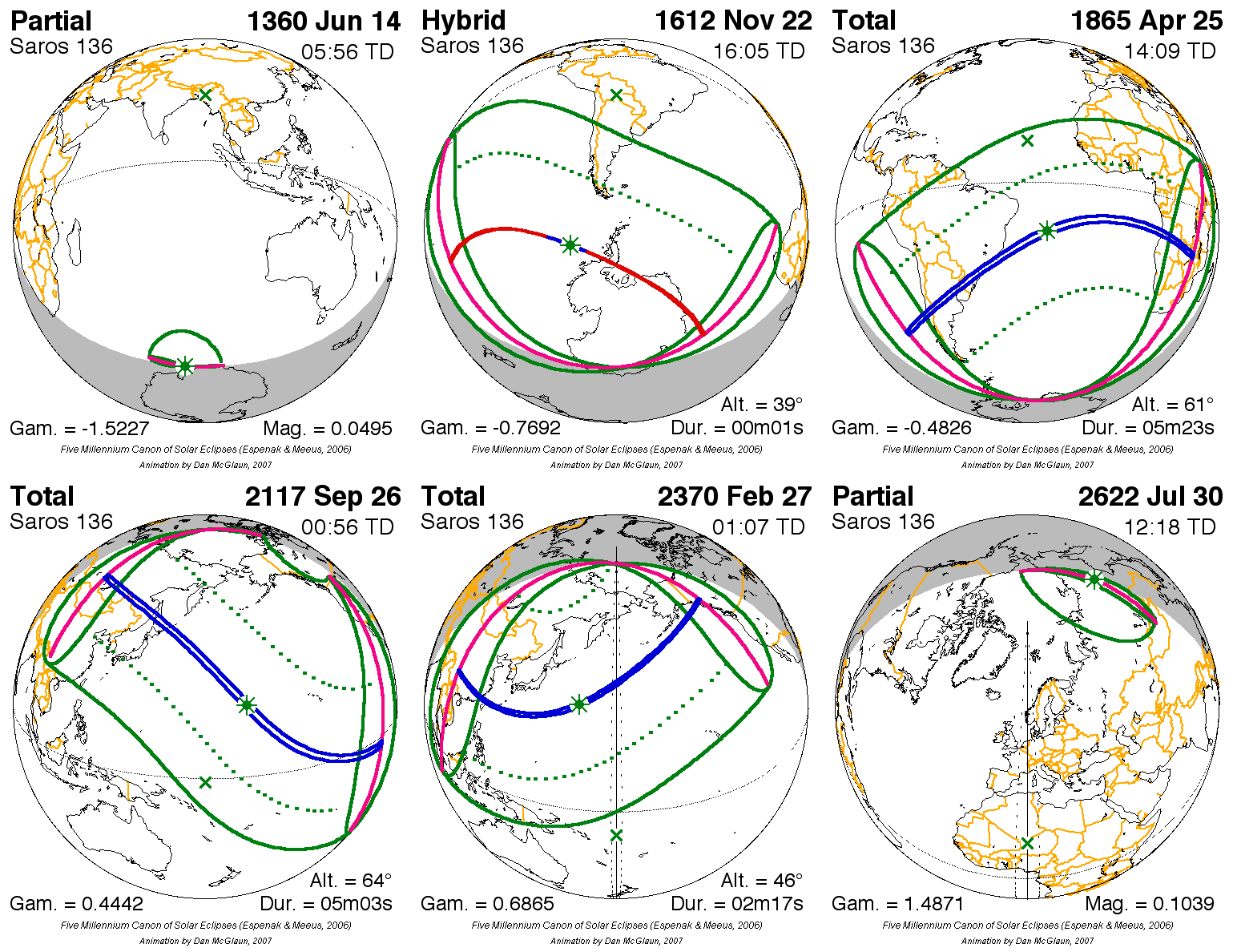
There is no fixed number of members. NASA gives a range of 69 to 87 solar eclipses for a complete Saros series, lasting about 1,226 to 1,550 years. Its members can include partial, annular, hybrid, and total eclipses. Belonging to the same family does not make every member a total eclipse.
The 2027 eclipse has a family history
The total solar eclipse of 2 August 2027 you can join with Total Together belongs to solar Saros series 136. NASA’s catalog lists 71 eclipses in this family, beginning with a partial eclipse in 1360 and ending with another partial eclipse in 2622. Across its lifetime, the series includes 15 partial, 6 annular, 6 hybrid, and 44 total solar eclipses.
The 2027 eclipse’s close relatives make the timing easier to see: previous members occurred on 11 July 1991 and 22 July 2009; the following member will occur on 12 August 2045. They are linked by the Saros, but their paths cross different regions of Earth. The long duration of totality in 2027 is a feature of this event and its geometry, not a guarantee that every eclipse in Saros 136 looks the same.
2026 and 1860: cousins, not siblings
Guests of Total Together’s 12th August 2026 eclipse had the opportunity to read Seymour Frost’s incredible zine about the 18 July 1860 total solar eclipse. Both the 1860 and 2026 eclipses passed over roughly the same region in northern Spain. So, are they related?
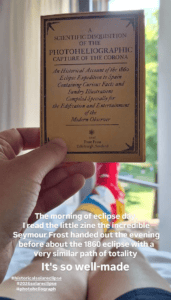
While the 1860 and 2026 eclipses are not related by astronomical cycles (like a Saros series), they are heavily related by geographic coincidence and historical legacy. From a scientific standpoint, they are completely separate cosmic events, but they share a special bond:
- Different Cosmic Families: The 1860 eclipse belonged to Solar Saros 124, while the August 12, 2026 eclipse belonged to Solar Saros 126. This means they were caused by completely different alignments and positioning sequences of the Moon and Earth
- The Geographic Twin Path: They are related strictly because the orbital math aligned perfectly to throw the Moon’s shadow across the exact same patch of Earth. Both tracks carved a diagonal path straight through northern Spain, passing right over approximately the same regions
- The Historical Passing of the Torch: Astronomers and institutions treat them as spiritual cousins. The July 18, 1860 eclipse is famous for being the event where humans first used photography to prove that solar flares belong to the Sun. The 2026 eclipse serves as the modern bookend to that historical breakthrough, allowing scientists to use advanced satellite imaging alongside ground observations over the same Spanish valleys
But this eclipse has already passed and stirred up quite the enthusiasm about total solar eclipses globally. Now we are turning our attention to the next total solar eclipse we can chase together.
Do longer cycles sit above the Saros?
There is a useful longer interval called the exeligmos: three Saros periods, or approximately 54 years and 34 days. After three sets of those extra eight hours, the timing is close to a whole number of days. Earth has nearly completed the extra rotation, so an eclipse path can return to roughly the same geographic region. “Roughly” matters; it is no promise of a repeat performance at one exact viewing spot.
The Inex, about 10,571.95 days, is another way of connecting eclipses. It links events around 29 years minus 20 days apart, generally at opposite lunar nodes. Astronomers use it to examine relationships between different Saros series. It is a separate pattern, rather than the next tier in a single ladder above the Saros.
Here is the practical hierarchy:
| Level | Unit or duration | What it tells you |
|---|---|---|
| Lunar months | About 27–30 days, depending on what is measured | When lunar phase, node position, and distance recur |
| Eclipse season | Roughly 31–37 days; seasons about 173.3 days apart | When an eclipse can occur |
| Saros | 223 synodic months; about 18 years, 11 days, 8 hours | Interval between successive eclipses in one family |
| Saros series | Typically around 12–13 centuries, with a variable number of eclipses | The complete family, from its first member to its last |
| Exeligmos | Three Saros periods; about 54 years and 34 days | A return to roughly the same part of Earth |
The wonder of eclipse cycles is that they make the sky predictable without making the experience ordinary. We can trace the 2027 eclipse back through centuries and forward to its future relatives. But to stand inside its particular shadow, on 2 August 2027, you still have to be in the right place at the right time, preferably with us 🥰
Leave a Reply