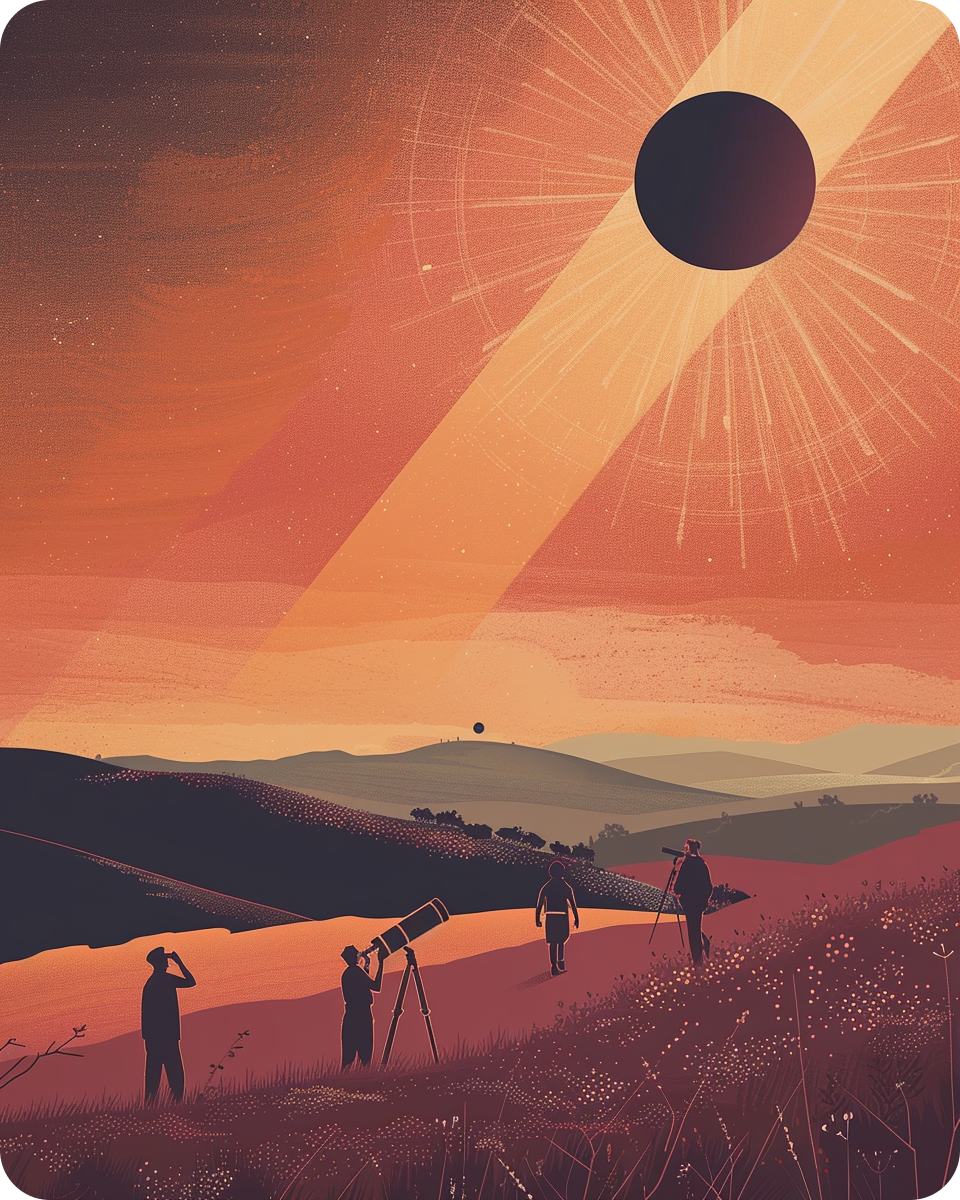
HALO (Human Alignment during a Lunar Occultation of the Sun) is an international field project documenting how people collectively experience totality during the 12 August 2026 solar eclipse.
Sensations
A total eclipse is more than darkness for a few minutes. People notice changes everywhere: in the sky, on the ground, in animals, and in themselves. There is sudden silence, excitement, emotion, and a powerful sense of sharing the moment with others.
These shared emotions matter. They play a role in how we feel connected and how we remember important moments. Yet they are rarely captured beyond personal stories, photos, or videos.
HALO brings this natural event and the human sensations together.
What HALO Does
HALO aligns three layers during a total solar eclipse:
1. the fixed astronomical timeline
2. human sensations in a specific location
3. short, voluntary reflections
Rather than reducing the moment to averages, HALO preserves variation across people and across time.
The goal is not to score or diagnose individuals, but to make collective patterns visible. All participation is voluntary and anonymised, in full compliance with European privacy regulations.
Why a Total Solar Eclipse
A total solar eclipse provides a unique reference point. Everyone shares the same external timeline, while individual reactions remain free to vary.
The sequence is clear and predictable:
first contact, partial eclipse, totality, sudden return of light.
This makes a total eclipse an exceptional opportunity to align environmental change and human experience across large geographic regions at the same moment.
Field Deployment
The first large scale field deployment of HALO will take place during the total solar eclipse of 12 August 2026.
An expanded deployment is planned for the 2 August 2027 eclipse.
Development Timeline
Preparation and technical development are currently underway for the 2026 deployment.
View detailed development timeline
January 2026
App design & concept development.
User flow and technical architecture.
Late February 2026
Video & audio research begins.
Collaboration with The Hague University of Applied Sciences.
March 2026
App build begins.
Operational development + exploratory wearable track.
April–July 2026
Development, integration & testing.
Field coordination across the eclipse path.
12 August 2026
LIVE FIELD DEPLOYMENT.
Real-time alignment of phases & collective sensations.
Late 2026 — Afterglow
Digital & physical visualisation.
Structured review and refinement.
2027
Expansion phase.
Broader deployment during the 2 August 2027 eclipse.
Contact
Marjan Schnetz
Founder, HALO
Email: info@moonmeetssun.com
Location: Spain / The Netherlands
Timi Trimmel
Total Together
Email: timi.trimmel@totaltogether.com
Location: Spain